
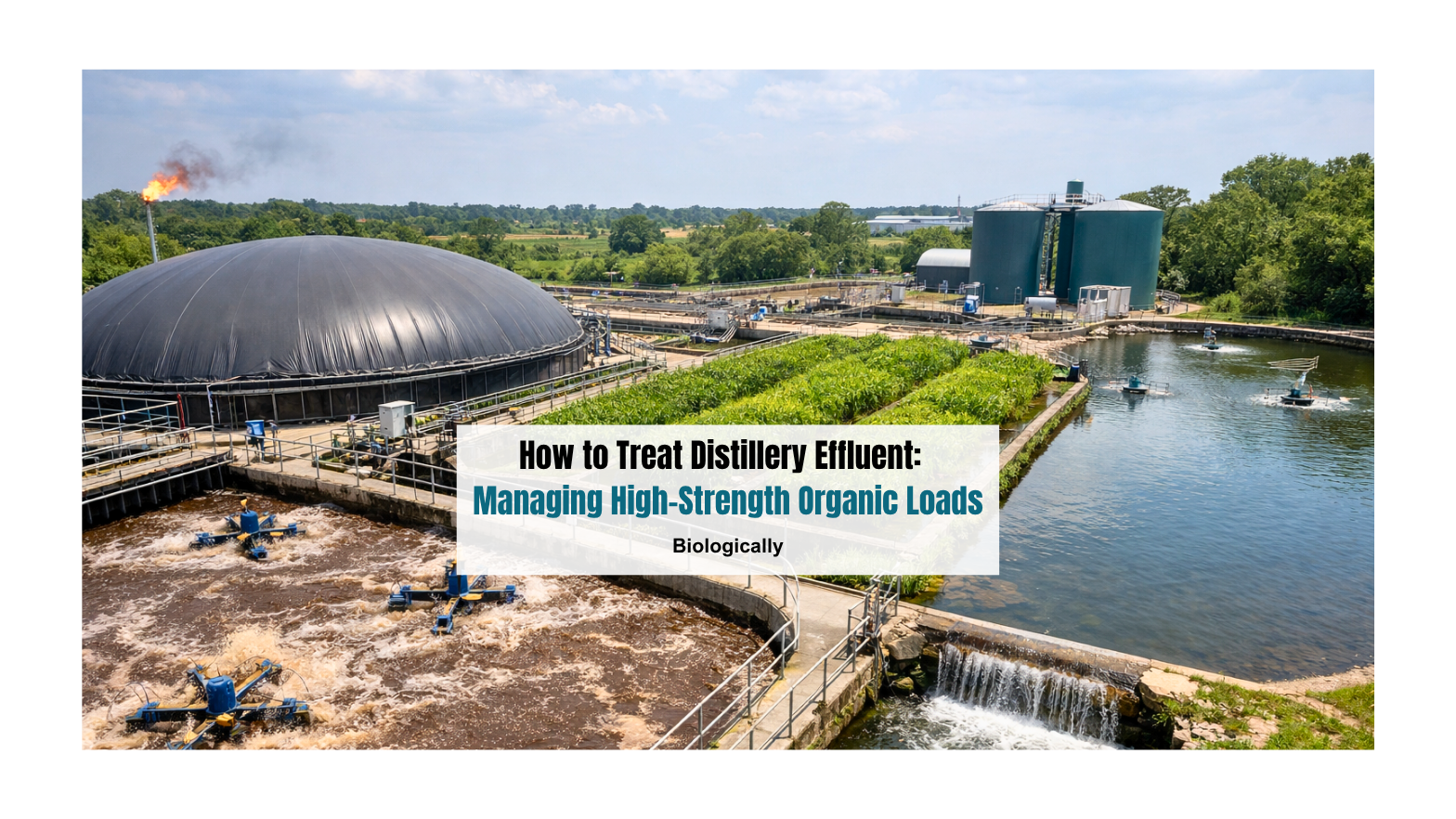

How to Treat Distillery Effluent: Managing High-Strength Organic Loads Biologically
The modern industrial landscape in India has reached a critical juncture. The dual pressures of economic expansion and environmental preservation are no longer negotiable; they are the two pillars upon which any successful enterprise must stand.
For the seasoned plant operator or the Environmental Health and Safety (EHS) manager, the transition from conventional treatment to the current era of Zero Liquid Discharge (ZLD) has been a profound paradigm shift. There is a specific, visceral kind of stress that only a professional in this field truly understands: standing on the catwalk of a treatment plant at two in the morning during a peak monsoon downpour, watching the foam rise in an aeration tank. In those moments, the weight of responsibility is heavy; a single non-compliant discharge could lead to a permanent closure notice from the National Green Tribunal (NGT) or the Central Pollution Control Board (CPCB).
The “hidden” cost of non-compliance is not merely the financial penalty, though those can reach into the crores, but the existential threat to the business itself. In today’s regulatory climate, authorities no longer just issue warnings; they revoke the Consent to Operate (CTO).
To thrive, the industry is moving away from a “hardware-centric” approach of simply building larger tanks. Instead, we are seeing a sophisticated, “biology-first” movement that prioritizes the optimization of microbial systems as the primary engine of detoxification. For the distillery sector, where organic loads are exponentially higher than municipal sewage, mastering this biological wastewater management is the only viable path forward.
The Anatomy of a High-Strength Challenge: Understanding Spent Wash
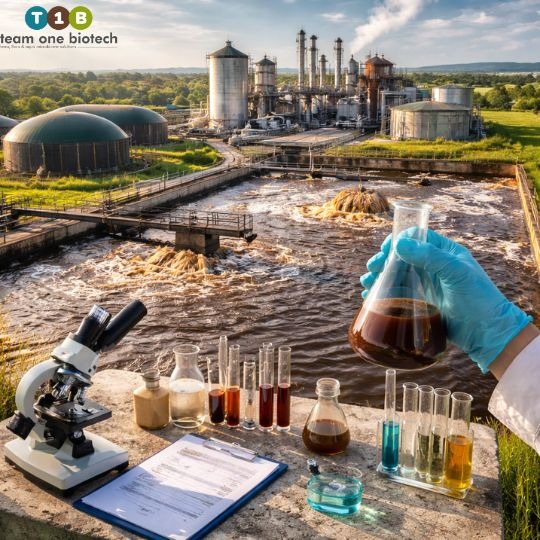
Distillery effluent, often called spent wash, stillage, or vinasse, is widely considered one of the most difficult industrial waste streams to treat globally. In India, where molasses is the primary feedstock for ethanol, the volumes are staggering. For every liter of alcohol produced, a typical distillery generates between 8.0 to 15.0 liters of spent wash.
The raw effluent is a dark brown, foul-smelling liquid that exits the process at high temperatures (up to 81°C) and with a highly acidic pH. Its organic strength is almost unparalleled. The Chemical Oxygen Demand (COD) and Biological Oxygen Demand (BOD) values are so high that direct discharge into a water body would result in the immediate and total depletion of dissolved oxygen, creating “dead zones” in our aquatic ecosystems.
Typical Characteristics of Raw Distillery Spent Wash
| Parameter | Typical Value Range (Raw) | Units |
| pH | 3.8–4.5 | – |
| Temperature | 71.0–81.0 | °C |
| Chemical Oxygen Demand (COD) | 70,000–150,000 | mg/L |
| Biological Oxygen Demand (BOD) | 35,000–60,000 | mg/L |
| Total Dissolved Solids (TDS) | 58,000–76,000 | mg/L |
| Potassium (K_2O) | 5,000–15,475 | mg/L |
The persistent brown color isn’t just an aesthetic problem. It is caused by melanoidins, complex polymers formed during fermentation. These compounds are remarkably resistant to standard treatment; they act as antioxidants that can actually be toxic to the very microorganisms meant to break them down. Furthermore, they block sunlight from entering rivers, halting photosynthesis and disrupting the entire food chain.
The Indian Regulatory Evolution: CPCB, NGT, and the ZLD Mandate
The regulatory landscape in India has evolved from simple “end-of-pipe” standards to a comprehensive, life-cycle approach. The mandate for Zero Liquid Discharge (ZLD) is now a baseline requirement for “Red Category” sectors like distilleries.
Under ZLD, no liquid waste is permitted to cross the plant boundary. Every drop must be treated, recovered, and recycled, leaving only dry solids for disposal. In states like Uttar Pradesh, the state pollution boards have been aggressive in enforcing these rules through Online Continuous Effluent Monitoring Systems (OCEMS).
Digital Surveillance and Continuous Compliance
With OCEMS, regulators have a 24/7 window into your plant’s performance. Parameters like pH, COD, and flow rate are transmitted directly to government servers. Deviations for even short durations can trigger automatic alerts and closure orders. This “digital surveillance” makes the role of specialized microbial cultures even more critical, as they provide the biological resilience needed to handle the “shock loads” that often lead to regulatory red flags.
The Science of Bioremediation: How Microbes Conquer Pollutants
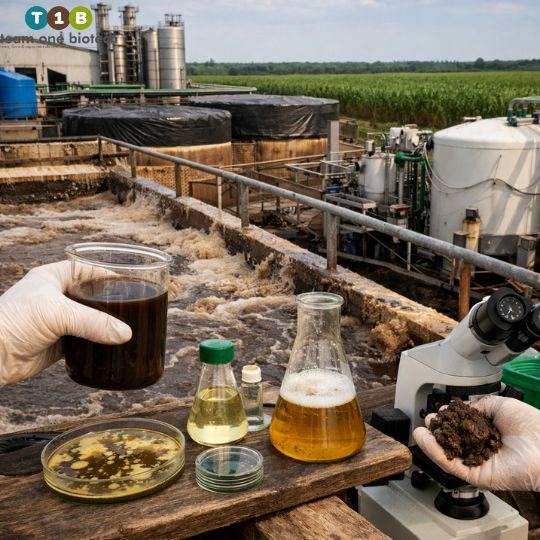
At the heart of a successful distillery Effluent Treatment Plant (ETP) is a complex ecosystem. Bioremediation is the strategic use of microbes to transform toxic substances into harmless forms. This is typically divided into two crucial phases.
1. Anaerobic Digestion: The First Line of Defense
The heavy lifting begins in anaerobic reactors, such as the Upflow Anaerobic Sludge Blanket (UASB). Here, a consortium of bacteria breaks down 60% to 85% of the COD, producing valuable biogas as a byproduct.
However, this stage is a delicate balancing act. If the organic loading rate is increased too quickly, the system can “acidify.” This is where the production of volatile fatty acids outpaces their conversion to methane, leading to a total system crash.
2. Aerobic Polishing and the Challenge of Recalcitrance
The effluent exiting the anaerobic stage still carries a significant organic load and that signature dark color. This is where aerobic treatment, the Activated Sludge Process (ASP), takes over.
To break down the stubborn melanoidins, you need “specialist” microbes like Bacillus, Pseudomonas, and Nitrosomonas. These microbes act like mini-biochemical factories, producing extracellular enzymes that function like chemical scissors to snip apart complex polymers.
| Enzyme | Mechanism of Action | Impact |
| Laccase | Breaks down aromatic rings | Key for decolourisation |
| Manganese Peroxidase | Degrades phenols | Deep COD reduction |
| Lignin Peroxidase | Cleaves complex C-C bonds | Breaks down recalcitrant matter |
Operational Hurdles: The “Pain Points” of the ETP Operator
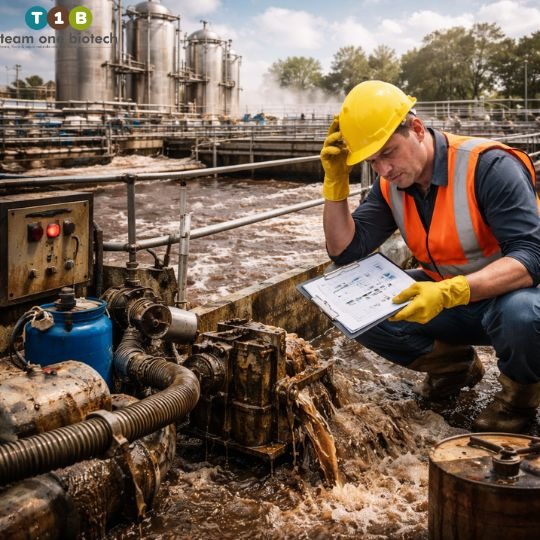
Maintaining a high-load ETP is a constant battle against biological instability. Operators often face three recurring nightmares:
Sludge Bulking
This occurs when the microbial mass becomes less dense and refuses to settle. Often caused by an overgrowth of filamentous bacteria during low oxygen levels, it can lead to a total loss of biological capacity as the biomass washes out of the system.
The Nutrient Imbalance
Microbes need a balanced diet. While distillery effluent is rich in nitrogen, it is often deficient in phosphorus. Without the right BOD:N:P ratio (generally 100:5:1), the microbes produce a “slimy” coating that makes the sludge notoriously difficult to manage.
The Monsoon Shock
In India, the monsoon is the ultimate test. Heavy rains can dilute effluent or cause rainwater ingress that exceeds the plant’s capacity. Power fluctuations during storms can also disrupt aeration, quickly turning a healthy aerobic tank into a foul-smelling swamp.
The Team One Biotech Advantage: Engineering Nature’s Solutions
Team One Biotech was founded on a simple principle: the world’s most significant pollution problems can be solved by its smallest inhabitants, microbes. Founded by Tejas Gathani, a veteran with nearly three decades of hands-on experience, the company addresses the “software” gap in wastewater treatment.
While many companies focus on selling heavy machinery, Team One Biotech positions itself as a strategic partner. They optimize existing infrastructure by enhancing the microbial engine that performs the actual detoxification.
Case Study: A Turnaround in Performance
A distillery struggling with high COD and unstable biomass implemented a targeted bioaugmentation program using the T1B Aerobio consortia. The results were transformative:
- COD Reduction: Effluent COD fell to a stable range of 650–870 ppm (an 80–89% improvement).
- Capacity Restoration: The plant returned to its full design capacity of 1,500 KLD from a restricted 500 KLD.
- Energy Savings: Improved oxygen transfer efficiency led to significantly lower power consumption for aeration.
Beyond Wastewater: A Holistic Ecosystem
The expertise of Team One Biotech extends across the entire environmental spectrum:
- Agriculture: Products like T1B Soil Biome enhance soil productivity and reduce the need for chemical fertilizers.
- Aquaculture: Probiotic solutions improve water quality and gut health for shrimp and fish farming without antibiotics.
- Lake Restoration: Reviving polluted urban water bodies using nano-bubble technology and microbial consortia.
- Commercial Cleaning: Nature-based enzyme cleaners that provide sanitation without a harsh chemical footprint.
Future-Proofing: The Path to Resource Recovery
As we move toward 2026, “success” is being redefined. The most advanced distilleries are no longer viewing effluent as waste, but as a source of revenue.
- Bio-CNG: The high organic content of spent wash is ideal for methane production, which can meet up to 60% of a plant’s energy requirements.
- Potash Recovery: Molasses-based wash is rich in potassium. The salts recovered during the ZLD process can be turned into potash-rich ash, a valuable fertilizer.
- Water Circularity: By optimizing biological treatment, distilleries can achieve water recovery rates of up to 98%, providing a stable water supply even in water-stressed regions.
A Vision for Sustainable Growth
The era of “dilution as the solution to pollution” is over. For the modern distillery, survival depends on a deep commitment to environmental stewardship. The regulatory pressure from the NGT and CPCB is not a hurdle to be jumped, but a permanent feature of the landscape.
Achieving excellence requires a shift in mindset. A treatment plant is not just a collection of steel and concrete; it is a living, breathing biological entity. By prioritizing the health of your microbial population and leveraging advanced bioaugmentation, you can transform your ETP from a source of stress into a cornerstone of operational stability.
The future of the Indian distillery sector is green, and it is powered by the intersection of science and nature. By embracing these biological solutions, we can ensure long-term viability, providing economic value to the nation and a cleaner environment for generations to come.
Move from compliance stress to process stability. Partner with Team One Biotech for your next biological audit.
Looking to improve your ETP/STP efficiency with the right bioculture?
Talk to our experts at Team One Biotech for customised microbial solutions.
Contact: +91 8855050575
Email: sales@teamonebiotech.com
Visit: www.teamonebiotech.com
Discover More on YouTube – Watch our latest insights & innovations!-
Connect with Us on LinkedIn – Stay updated with expert content & trends!